Lambousa
The
ancient kingdom of Lambousa (translates as -the shining one-) was founded by
Phoenician traders in the 8th century B.C. and remained a quietly prosperous
until the Christian era, when groves of mulberries fed a highly profitable silk
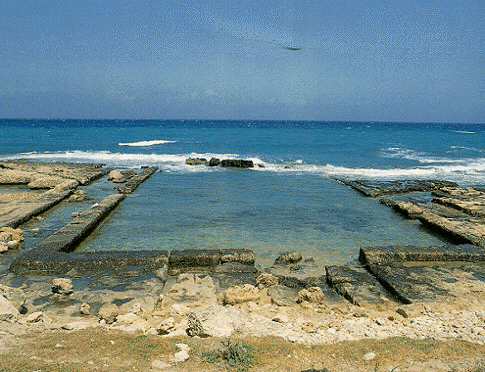
industry. The foundations of a lighthouse, sea-water fishponds and a portion of
the city's wall survive from the 6th century Byzantine town. A silver dinner
service from this period was found here in the early years of this century,
presumably hidden just before the Saracens sacked the city in the 7th century.
 It
is the finest example of secular art from early Byzantium and is now split
between the collections of the Metropolitan, British and Cyprus museums.
It
is the finest example of secular art from early Byzantium and is now split
between the collections of the Metropolitan, British and Cyprus museums.
Lambousa was revived as a port,
though all that remains from this second period are three distinctive medieval
churches.
The 13th century double-doomed
Monastery of Akhiropietos (translates as -Built without Hands-), was erected
over the ruins of an old cathedral. Akhiropietos was enlarged in the 15th
century, at the same time that the ancient shrine of St. Evalios was also
completely restored.
 The
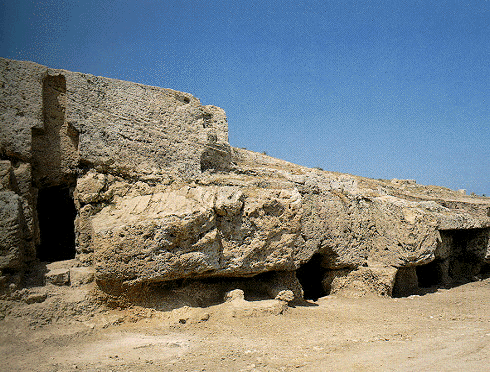
curious rock hewn chapel of St. Eulambios is the core remnant of an old quarry.
It was turned into catacombs in the late Roman period, and is where the body of
Eulambios, an elderly martyr, was interred.
The
curious rock hewn chapel of St. Eulambios is the core remnant of an old quarry.
It was turned into catacombs in the late Roman period, and is where the body of
Eulambios, an elderly martyr, was interred.
In the last years excavation
works have re-started at Lambousa by the Department of Antiquities in
collaboration with an archeological team from Germany, and the site is being
planned to open to public as an open air museum in 1996.
Related Links
•
Rogerson, B., (1994), Cyprus,
Cadogan.

 Kyrenia